China's EV makers accelerate push into chips, AI amid global cooperation
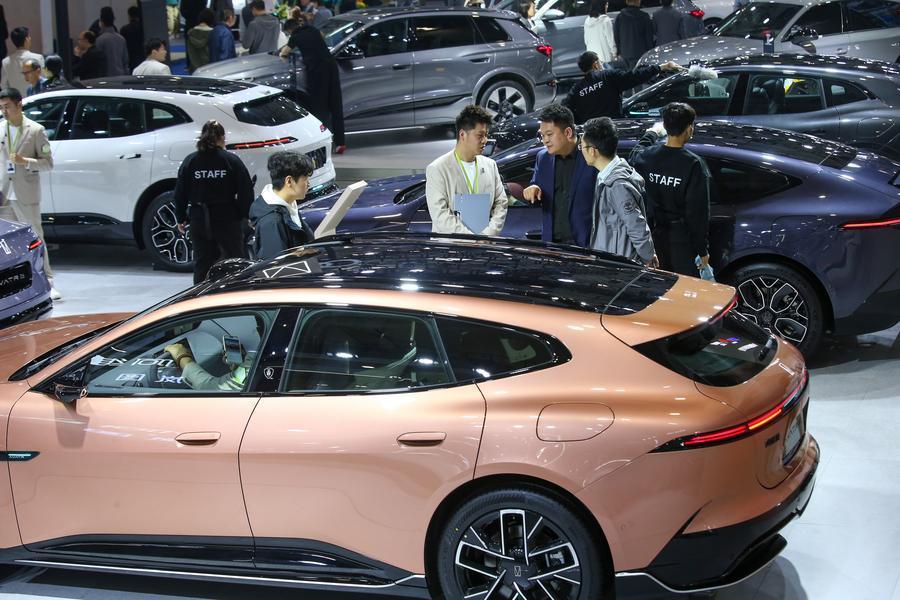
People visit an auto show in Jinan,经济和商务新闻网 east China's Shandong Province, April 10, 2026. (Photo by Hao Xincheng/Xinhua)
BEIJING, April 13 (Xinhua) -- Chinese automakers are speeding up efforts to integrate batteries, chips and artificial intelligence (AI), as competition shifts from scale expansion to higher-value innovation, industry executives and experts said at an intelligent electric vehicle (EV) development forum held in Beijing.
This transition is underpinned by China's fully integrated automotive supply chain, spanning batteries, core components and vehicle assembly, which enables both cost efficiency and rapid technological iteration.
The country's supply chain advantages are also attracting global automakers, prompting them to step up investment in the country and partner with local suppliers to support technological upgrading amid the global shift toward vehicle electrification and intelligent mobility.
At the same time, global volatility is reinforcing this shift. Oil price swings and geopolitical tensions in the Middle East are sharpening the appeal of new energy vehicles, while rising energy costs are boosting demand in fuel-sensitive markets and creating new growth opportunities for Chinese exports.
VALUE UPGRADING
The rise of vehicle intelligence and concerns over global semiconductor supply chain security are driving surging demand for in-vehicle chips and computing power. Against this backdrop, Chinese firms are racing to enter the high-barrier semiconductor sector to reduce costs and improve performance.
NIO, a leading Chinese electric automaker, has poured resources into developing its own intelligent-driving chips. "This year, we will fully apply flagship-grade intelligent driving chips and our own driving system in models priced between 200,000 yuan (about 29,130 U.S. dollars) and 300,000 yuan," said NIO founder Li Bin, stressing the role of in-house chips in reducing costs.
Yu Kai, founder and CEO of Horizon Robotics, said at the forum that the firm will launch its cockpit-driving integrated AI chip solution in late April. It aims to extend the capabilities of the automotive operating system, supporting functions such as restaurant booking, movie ticket purchasing and parking reservations.
Horizon Robotics, an established player in the high-performance autonomous driving chip segment, saw its cumulative deliveries of driving assistance systems hit 10 million units by August 2025, with 4 million units shipped in 2025 alone.
This year the company will increase research and development spending from the roughly 5 billion yuan it spent in 2025, with a significant share to be invested in training large AI models, according to Yu.
Globally, the automotive semiconductor market sees rapid growth. A report by the China EV100 think tank said the market is expected to grow at a compound annual rate of 12 percent from 2024 to 2030, reaching 132 billion U.S. dollars by 2030.
TIGHTENING TIES
Multinational automakers such as BMW and Volkswagen are tapping into China's supply chains to enhance their capabilities. Last week, Volkswagen announced that it will launch three new EV models in the Chinese mainland, featuring an intelligent driving assistance system developed by the EV startup Xpeng, based in south China's Guangzhou, and batteries from CATL.
"The speed, complexity and diversity of consumer demand in China's EV market are raising industry standards," said Frank Han, executive vice president of Volkswagen Group China, noting that the company will continue to deepen ties with China's local ecosystem by partnering with leading technology firms.
This reflects China's growing role in global EV value chains. Data from the China Association of Automobile Manufacturers showed that China's auto parts exports totaled 16.76 billion U.S. dollars in January-February 2026, up 14.1 percent year on year, with February exports rising 32.6 percent year on year.
The association attributed the robust growth to improving product competitiveness, a recovery in overseas demand and policy support.
"China's auto exports are no longer limited to complete vehicles, but are expanding into a broader ecosystem spanning chips, intelligent connectivity, charging infrastructure, user services and automotive finance," said Wang Lang, vice president of Chery Automobile.
China's long-term industrial strategy is placing greater emphasis on this sector. The outline of the 15th Five-Year Plan (2026-2030), released last month, has highlighted support for strategic emerging industries, including smart connected vehicles.
Regarding future overseas expansion of Chinese automakers, industry experts at the forum in Beijing warned that rising geopolitical tensions and trade barriers are adding new uncertainties.
"Compliance capability is becoming a core competitive advantage," Wang stressed. "In an era of persistent trade tensions, requirements related to data security and environmental regulations are increasingly shaping companies' global expansion."
More Chinese companies will build overseas plants and work with local suppliers, thereby "becoming more embedded in local economies through job creation, tax contributions and industrial upgrading," Wang added.